Background

Showing posts with label Dry Erase Templates. Show all posts

Friday, June 2, 2017

Completing the Square Dry Erase Templates

Here is another one of my dry erase templates. This template has changed several times since it was one of my first and I just keep thinking of better ways for students to process through completing the square. My latest version incorporates the box method since we use that to multiply and factor polynomials in my class. If you haven't seen my other templates you should check them out.


Version 1:


Version 2:


Version 3:


Examples of Student Work:


If you would like to download these files you can find them below:


Tuesday, May 30, 2017

Resources for Factoring Trinomials

Well this post was supposed to just be a quick post to link my factoring puzzles activity but it has turned into a longer blog to share all the resources I have used this semester (Spring 2017) for teaching factoring. So here are my activities that I feel really helped students with factoring this year. I am so happy with the way these activity turned out. 

I learned all about the box method for factoring last summer while scrolling through twitter one night. It was life changing and I'll never go back!! If you haven't heard about this method you should check out this blog (Polynomials and Box Method) I did recently. 

This semester I had two different preps Math 1 and Math 2, I started teaching quadratics early in Math 2 and hadn't made these resources at that point so it didn't go as smoothly. When I started quadratics in Math 1 I did these things that helped lead up to the factoring process. (We have previously covered Multiplying Polynomials & Factoring Polynomials by GCF)


2) Factoring Puzzles


4) Notes on Factoring Trinomials


5) Practice on Dry Erase Template Factoring Trinomials


Here are some student photos of the activities being used:


If you would like to download these files you can find them below:


Monday, May 29, 2017

Simplifying Radical Expressions Dry Erase Templates

Today I want to share another dry erase template with you that I tweeted about last week on simplifying square roots. This is probably the most retweets I've had yet so I know that you guys are looking forward to this file!!


I also created a different version for cube roots since we cover this in math 2 as well. Hope you guys enjoy. I haven't had the chance to use these yet since we are now finishing up our last week of classes and exams start next week but I'm super excited to use this template next year. I think having a printed copy of all the perfect square and cube numbers will help remind students which numbers need to be factors of the original number. 

This idea was sparked first by seeing Sarah's version (pictured below) which is pretty cool too. She uses the birthday cake method of finding the prime factorization of a number. Check it out here.


If you notice in the tweet pictured I forgot to list my prime numbers like Sarah has in hers so I made another file with the primes. This will be more helpful to students when they are looking for their stop number in my method.

Now in my method the stop number will NOT always be a prime number like 30 for example. This number is a stop number bc the perfect squares below the number (4, 9, 16, 25) do not divide evenly into that number and the next perfect square (36) is too big. I tell my students when trying to find factors if the perfect square number they are trying is bigger than the number in their tree then it is a stop number and that it stays under the radical. This method may seem harder than taking the prime factorization of a number but with larger numbers it goes faster and has less work so I guess that is why I like it better.


Here are the two versions I have for Simplifying Square Roots

Squares - Version 1 (without primes):


Squares - Version 2 (with primes):


Here are the two versions I have for Simplifying Cube Roots

Cubes - Version 1 (without primes):


Cubes - Version 2 (with primes):


Student Work Examples:


If you would like to download these files you can find them below:

Simplifying Square Roots (without primes)
Simplifying Square Roots (with primes)

Simplifying Cube Roots (without primes)
Simplifying Cube Roots (with primes)


Do you want to see more of my dry erase templates???


Check out these other blog posts below:


Also in the future all of my resources will be uploaded in a google doc with links to each blog post so you can find things nice and easy. You can find these resources in the virtual filing cabinet tab on my blog page.


Quadratic Formula Dry Erase Template

This idea came from Sarah when I saw her quadratic formula template. I teach this topic a little different so I modified it to fit the method I use in the classroom. Below you will notice with more time I have changed these templates again to hopefully make them more understandable to my students. 


Sarah's Original:


Modified Version 1:


Modified Version 2:


Examples of Student Work:


If you would like to download the files you can find them below:


Monday, May 8, 2017

Systems of Linear Equations (Elimination)

Super excited to share these resources with you today after all the amazing feedback from twitter. Last week I shared a photo of my newest dry erase template that I use to help guide students through the elimination process and I got so many great responses that I had to put this at the top of my list to blog about.


Over the years I have seen that students really struggle with solving systems of equations by elimination. When teaching I try to find a process that will be consistent so students can repeat the same steps and eventually remember how to solve a particular problem. There are definitely faster ways to solve the systems than I teach them but this process works for all the problems if they are in standard form. 

I have students focus only on eliminating the x's even if the y's look easier. Once they understand the process I then tell them about finding shortcuts. So if we focus on eliminating the x's first I tell them the coefficient has to have the exact same number but different signs so that the x's cancel out to zero and disappear. We practice flipping the coefficients and then multiplying to essential have the same coefficient for the x's. Then I ask them if they already have different signs. If they do then we go into the elimination step. If they do not I tell them to ONLY multiply the TOP equation by a negative. Before we go into the entire process I practice just determining what to multiply each equation by to solve. So I created a card sort activity to practice that. Remember that I am focusing on the x's. If you do not do it this way then you will probably find these resources need to be modified to fit your needs. 

Here are the notes I start with to teach this topic. We focus on the rule part at the top for a little while then finally move to actually solving the equations at the bottom once I feel like they understand what we need to multiply by to eliminate one of the variables. 


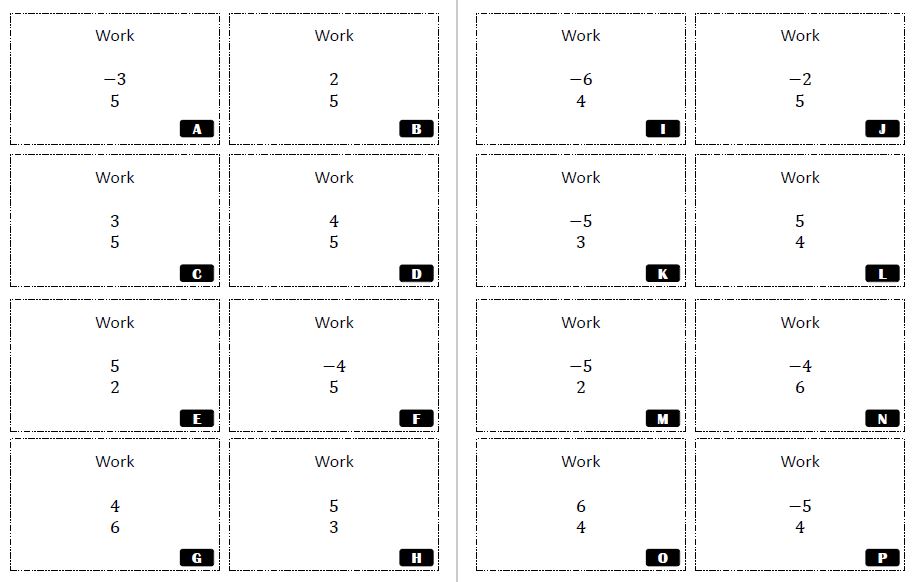
Here is the card sort activity that I use to help reinforce what they must multiply by to have the x's eliminate.


You may notice that many of the problems have the same numbers in the front of each equation. I purposely did that because I wanted to force the students to really have to think about what they needed to multiply by and not just match up the numbers. Most of my card sorts I try to do this. I find similar problems that have only a few changes so they really have to focus on the rules and steps of a concept. 

Like factoring trinomials for example, I try to make sure that other trinomials share a common factor and also make sure 3 or 4 trinomials all start with the same coefficient so it isn't easy to just match up by multiplying the first two parts of each factor. 

Here is the dry erase template that I use to practice solving systems of linear equations by elimination. 


***Update*** I totally forgot about the truths & lies activity that I made for elimination. I love this activity because it focuses on students having to find mistakes and fix those problems.


Hope you guys find these resources helpful. If you would like to download the files you can find them below. 

Notes for Solving Systems of Equations by Elimination
Card Sort for Multiplication Process of Elimination
Dry Erase Template for Solving Systems of Equations by Elimination
Truths & Lies Activity for Solving Systems of Equations by Elimination


Do you want to find more resources like this??? 


Saturday, May 6, 2017

Polynomials & Box Method Spring 2017

This summer I learned about the box method used for factoring from Sarah over at mathequalslove. I found this method extremely helpful because it was consistent across many different topics and simple to understand. I really appreciate how it helps keep my problems organized. Here are the topics I have used this method with:

* Multiplying Polynomials
* Factoring GCF out of Polynomials
* Factoring Trinomials
* Solving Quadratic Equations by Factoring

***I have also seen this method done with Long Division of Polynomials (don't teach currently)***
You can check out Sarah's post here.

I have made notes using this process as well as dry erase templates for my students to use as they are practicing this skill in the beginning. I have found that lower level students who struggle to keep up with all the different steps try much harder if given a dry erase template as a guide. Also this really helps teach them to keep all their work nice and organized.


As you can see the template is already set up to handle up to a trinomial times a trinomial but students also do not need to use the extra rows and columns if they have smaller polynomials to multiply. 


The template for factoring out the greatest common factor from any polynomial is designed to handle up to four terms as I usually don't do examples greater than that anyways. I did notice that you also might want to limit it to about three variables so that students have enough room to write their letters in the blocks. I'm really glad that I decided to do gcf with the box method also because it makes transitioning into box with factoring trinomials much easier. 


I love this factoring trinomials template. It was not my original idea as most of my ideas are sparked from great resources around the MTBOS. Unfortantly I can't remember exactly who designed this model but if it is yours please let me know so I can tag your blog here as another resource for those interested in this method. 


More recent document shown below. Can't remember who I saw post on twitter that they had students always say what the gcf was even when it was 1 and I loved that because then they won't forget to look for it. So I had to include it in the new file. 


I love to check out the latest posts and blogs with tons of photos of how other teachers present their content. So hopefully these notes and pictures can inspire someone else out there. If you modify any of these I would love to see your idea as it my be better and make me want to steal your brilliance :)


Here are the files found in this document:

Multiplying Polynomials - Notes & Dry Erase Template
Factoring Polynomials GCF - Notes & Dry Erase Template
Factoring Trinomials - Notes & Dry Erase Template
Solving Quadratic Equations using Factoring - Notes & Dry Erase Template


Do you want to find more resources like this???